
Building Connections
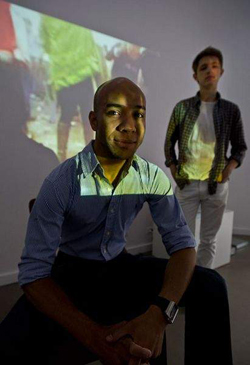 by Diane Heilenman for The Courier Journal
Ironic.
Millions are connected at the level of intimate thought and images via the Internet, but in the physical world -- and Louisville is an example -- traditional neighborhood boundaries can defy those connections.
One Louisville artist and entrepreneur is among those building new connections in the physical and virtual worlds.
"In the spirit that made this city a city, I'm a pioneer, pushing west," said Bryce Hudson.
An artist represented by Louisville's Gallery NuLu, Hudson also is a successful Web designer, and he opens the first exhibition -- of digital art, naturally enough -- at his new combination gallery and studio, Plexus, in the Portland neighborhood west of downtown Louisville.
"Build a Fire" was organized by curator Ilia Ovechkin, 21, a Louisville native attending the Maryland Institute College of Art in Baltimore, which many of the nine artists in the exhibit attend or attended.
"A lot of it is very new, very new thinking, experimental," said Hudson, 29.
 These artists are influenced by visual arts that run powerfully outside the conventional, such as film, special effects, anime, video games, comic books and advertising, even early 'net art. They were born after the early Internet years and are fluid, accomplished and unself-conscious computer geeks.
Hudson, who is biracial, said he realizes that his presence in Portland is experimental too.
The neighborhood of bungalows, shotgun houses and corner stores in 19th-century buildings is robustly white and lower middle class. Hudson, whose abstract art or staged photographs are often about the disconnects between genders, races and social constructs, formed Adorno studio at 24th and Main streets in Portland nearly four years ago with Cynthia Norton and Nico Jorcino.
Hudson, who lives on Cherokee Road near downtown, likes Portland a lot.
"I was looking for a great place to work that I could afford," he said. He bought and renovated a sturdy 1920s brick medical clinic at Portland Avenue and 24th Street last summer.
With Ché Rhodes, head of the glass program at the University of Louisville, also moving to Portland with a home studio, that makes at least three art studios in the area.
"I want to prove to myself and prove to others that not only is it possible (to connect with Portland), but it's the direction the city needs to move," said Hudson. "This neighborhood has more choices (than other parts of Louisville). It just seems more real and unique to me. I'd rather be here than on Hurstbourne Lane."
Hudson said he sees it as a "great financial decision" with resale possible in five or 10 years. He said he makes a good living at Web design and his other artwork sells well, too, so "I don't have to be a commercial success (at Plexus)."
Hudson is a former psychology major at Kent State University who moved to Louisville and took up social work. When he burned out on that, he got a degree in graphics and Web design at Sullivan University and began to pursue art seriously.
"Through all that, I got to figure out that networking, that was really what works. Plexus means a network. It's more or less a contemporary idea of exhibiting and introducing people to art and artists to other artists."
The space is like the show, he said. It's not necessarily commercial but is about discussion and discourse.
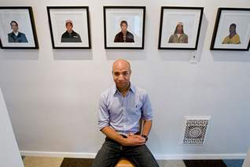 "I've always strongly believed that if I have the opportunity I should assist others in finding collectors, making sales," Hudson said.
He embraced the cubicles used for medical exams in the former clinic and saw that they would solve the problems most museums and galleries have in showing digital arts and time arts that require intimate dark spaces instead of vast, open galleries.
The first show is a perfect fit.
The artists are of the coming generation of digitally literate creators who will help define the future of contemporary art.
A signature work is "slow rave (last minutes of trance energy)" 2006 by Damon Zucconi of New York City. He took 10 seconds of a real rave and stretched it to three minutes and 24 seconds, using a software that fills in what would otherwise be "blanks" between stills. This creates a very slow motion with rational-looking but artificial, computer-based movement. It is a crown jewel of "Build a Fire" because it shows the increasingly deep layering of different and equally valid realities in the Internet age and shows off the computer's ability to combine and integrate images based on its own internal binary functions.
Another gem is the touching visualization of impossible self-discovery with gay and burlesque-hall overtones. The figure, dressed in two different white bodysuits, is shown in a diptych format. Jacolby Satterwhite of New York City gestures and vamps to a song written and sung by his mentally ill mother about her longing to pull her life together and discover herself.
Reporter Diane Heilenman can be reached at (502) 582-4682.
-- Diane Heilenman
 My FaceBook profile
 Flickr Photos
 Favorite Bookmarks
 Instant Message Me!
 My LinkedIn Profile
 My Vimeo Videos
 My Twitter Updates